
India's T20 Batting Order Future: Vaibhav's Rise
India's T20 batting order faces exciting questions as young Vaibhav Sooryavanshi shines, prompting strategic shifts for future tournaments.
The Cliff News | 29 October 2026
With the T20I series against New Zealand already secured, the Indian team management faces a pleasant dilemma: how to best construct the batting order for the long term, specifically looking towards the 2028 T20 World Cup in Australia and New Zealand. The emergence of young talent like Vaibhav Sooryavanshi is adding a compelling new dimension to these strategic discussions.
Sooryavanshi’s explosive 45 off just 19 balls in the third T20I in Wellington has significantly amplified this selection consideration. Initially handed an opportunity due to Ishan Kishan’s injury and deployed at number three in Christchurch, Sooryavanshi found himself batting outside the powerplay, which seemed to disrupt his natural aggressive style.
A New Opening Partnership Emerges
However, when India promoted him to open alongside Abhishek Sharma in Wellington, the 15-year-old prodigy showcased his belligerent best. He immediately set the tone by smashing the first ball to the boundary and maintained that aggressive approach throughout his innings.
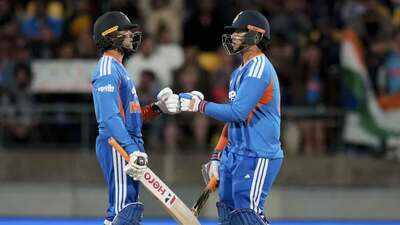
While Abhishek Sharma’s century was the headline, Sooryavanshi’s fearless attitude provided the impetus. The pair forged a remarkable 133-run partnership in just seven overs, overwhelming the New Zealand attack. This formidable stand offered a glimpse into the mindset of a new generation of T20 batters who view every delivery as a scoring opportunity.
Samson's Selfless Shift
This strategic repositioning of Sooryavanshi carried a significant subplot: Sanju Samson willingly moved down to number three, despite having enjoyed considerable success as an opener. Since returning to the side midway through the T20 World Cup, Samson had formed one of India’s most productive opening partnerships with Abhishek Sharma, accumulating 1,166 runs in 37 matches and becoming a fixture at the top of the order.
Abhishek Sharma was quick to acknowledge Samson’s sacrifice. He stated in a BCCI video, “The way Sanju bhai batted in the last game, it is not easy to let go of one’s familiar batting position. That showed his character. Someone’s going for his position but everyone is selfless and happy for each other, which is the hallmark of a great team.”
Embracing Flexibility Under Gambhir
This willingness to adapt and prioritize the team's needs over individual preferences highlights a key characteristic of the current Indian side. Under coach Gautam Gambhir, the team appears to be moving away from rigid positional adherence, embracing flexibility for the greater good.
The team management is now focused on evaluating the potential of the Vaibhav-Abhishek opening pair. Sooryavanshi himself admitted that batting at number three in Christchurch had hindered his natural game. He commented, “Last match, I went against my grain as to how I play in T20s. This game, I wanted to give a quick start so that it becomes easy.”
Clarity in Sooryavanshi's Approach
His Wellington performance strongly supported this assessment. As an opener, his approach was characterized by clear intent and aggression. He did not need to assess conditions or pace his innings; it was an all-out attack from the outset. Abhishek Sharma felt the impact of this fearless approach from the other end.
“When Vaibhav hit the first ball, he showed aggression. I saw that at the non-striker’s end and when you see such a shot, you also feel pumped up. Special mention and credit to Vaibhav for how he played,” Abhishek remarked, underscoring the symbiotic nature of their successful partnership.
The Challenge of Full Strength Selection
The primary challenge now lies in accommodating all key players when India returns to full strength. Sooryavanshi’s impressive emergence, particularly following his performances in IPL 2026, makes it increasingly difficult to keep him out of the playing XI. However, India already boasts established performers like Sanju Samson and Ishan Kishan.
The debate doesn't necessarily need to be framed as Vaibhav versus Sanju or Vaibhav versus Kishan. Head coach Gautam Gambhir has consistently emphasized that only the top two batting positions are relatively fixed, with the rest of the order remaining flexible. Ishan Kishan's adaptability further supports this strategy.
Kishan's Versatility as a Blueprint
Kishan demonstrated his ability to thrive outside his preferred opening slot during the Asian Games semifinal against Sri Lanka, where his match-winning 80 off 46 balls came at number five. This performance offers a potential blueprint for how all four talented batters—Sharma, Sooryavanshi, Samson, and Kishan—can feature in the same playing XI, albeit in different roles.
With the series already decided, India has the luxury of looking beyond immediate results and focusing on building a formidable and flexible T20 unit for the future. The ongoing evolution of their batting order, marked by young talent and seasoned players demonstrating team-first attitudes, signals a promising direction for Indian cricket.